Shelagh's Lens
Bringing Vancouver and the world to inspired travellers
Parisian Blue

 Walking down Avenue de l’Opéra in Paris, there are interesting sights every few steps. This is, after all, the road that takes one from the Opera House (Palais Garnier) to the Louvre; it’s a major road constructed as part of Georges-Eugène (“Baron”) Haussmann’s late 1800s redesign of Paris.
Around the corner from our hotel and in the centre of the city, this is also home to numerous shops and financial institutions. We passed these tall, double blue doors at least twice daily, and they drew a smile each time.
Share this post, and Shelagh's Lens, with others who love to travel

Cloud Gate
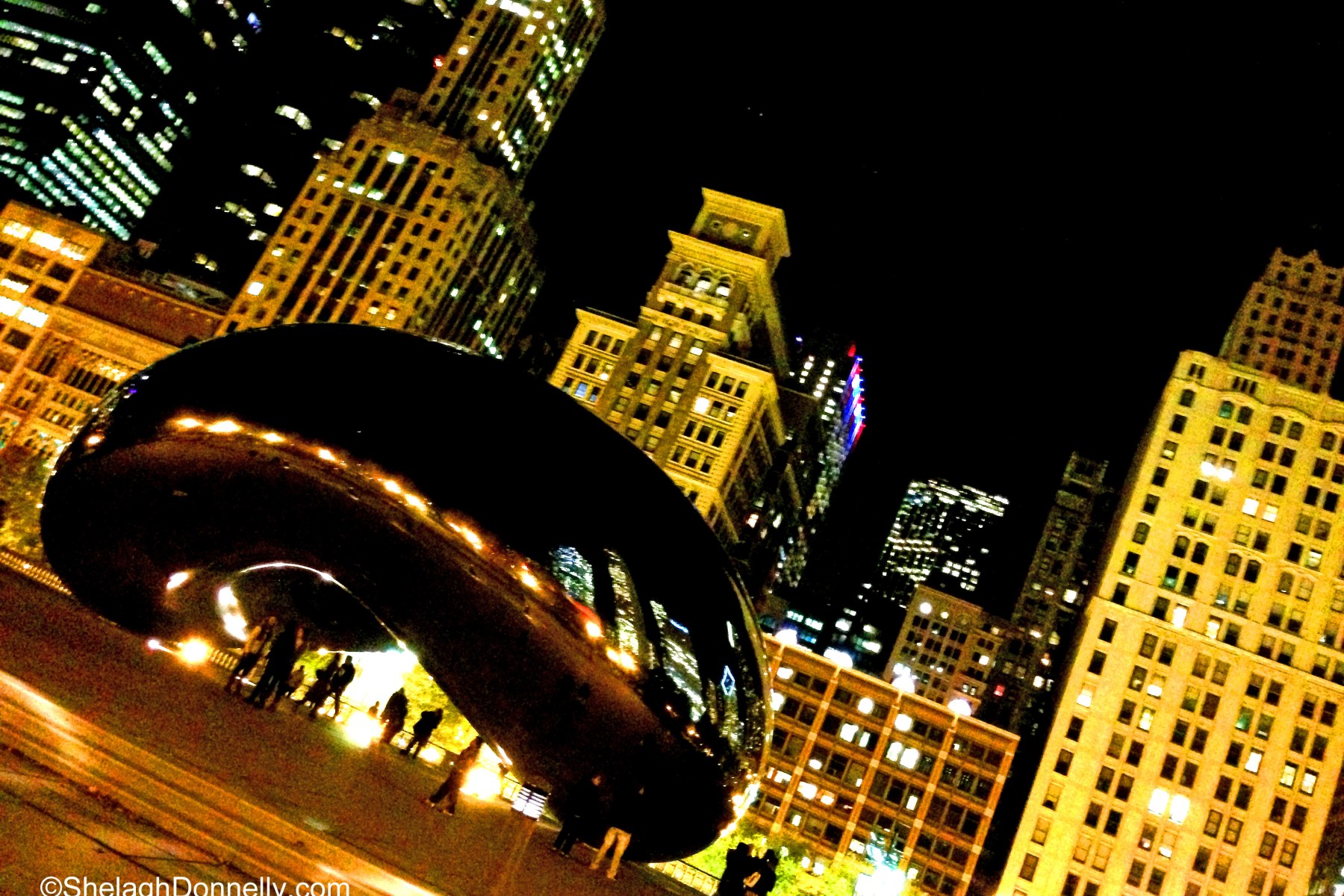
… which locals also call The Bean, is Anish Kapoor‘s contribution to Chicago – much to the delight of those who visit Millennium Park.

Think back to science studies, and imagine ever so carefully letting a drop of liquid mercury down upon a plaza. A 1110 ton drop that rests more than 10 meters high by 20 meters (or 33 feet high and 66 feet ) wide, that is.
The Bean is a giant and visually seamless stainless steel mirror that draws crowds with cameras and their giggles as they snap distorted images of themselves and the Chicago skyline. Walk through the underside of the bean, and you’ll enjoy amplifications of distortion. Years seem to fall away from the faces of even the most jaded visitors , as they join the chronologically young in the fun.
The Bean is a a visual treat by day, and even more dramatically so by night.
Share this post, and Shelagh's Lens, with others who love to travel

Give the Lady What She Wants
Back from Chicago for a few days now, I’ve spent the balance of the week working like a fiend. When I’ve been able to come up for air, conversation has typically included encouragement that others visit this friendly, fascinating and – yes – windy city.
Where else can you stroll in to a department store where it’s the architecture and not the goods on display that first captures your eyes and heart? The new signs may read Macy’s, but it’s Marshall Field and Company (Marshall Field’s) that lives on at State and Washington in the Loop, and in Chicagoans’ hearts. Mr. Marshall Field’s motto for his urban shoppers? “Give the lady what she wants.”
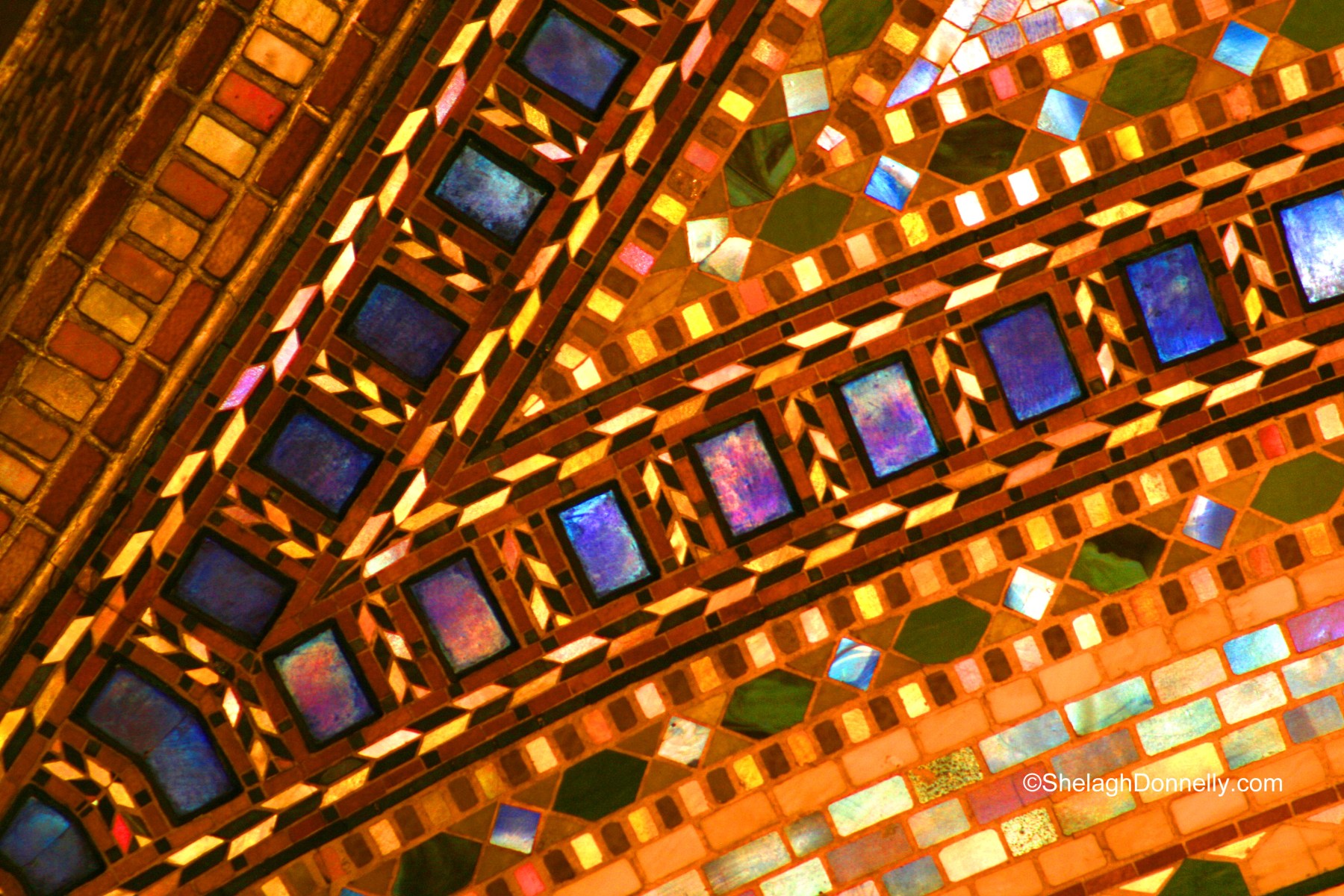
With roughly two million square feet of space, this is the second largest retail store in the US. It’s second only to Macy’s Herald Square store in New York , where I can tell you the ladies’ shoe department is bigger than some suburban department stores. This Marshall Field’s/Macy’s store is not, however, a monolithic big box . It has a number of atriums and nothing less than a magnificent glass ceiling by Tiffany & Co. It’s a wee corner of that ceiling you see in the photo above.
The building made its way in 1978 to the US’ National Register of Historic Places, and locals ensured it received Chicago Landmark status in late 2005, just in time to ensure that incoming owner Macy’s had no opportunity to strip away the building’s architectural past.
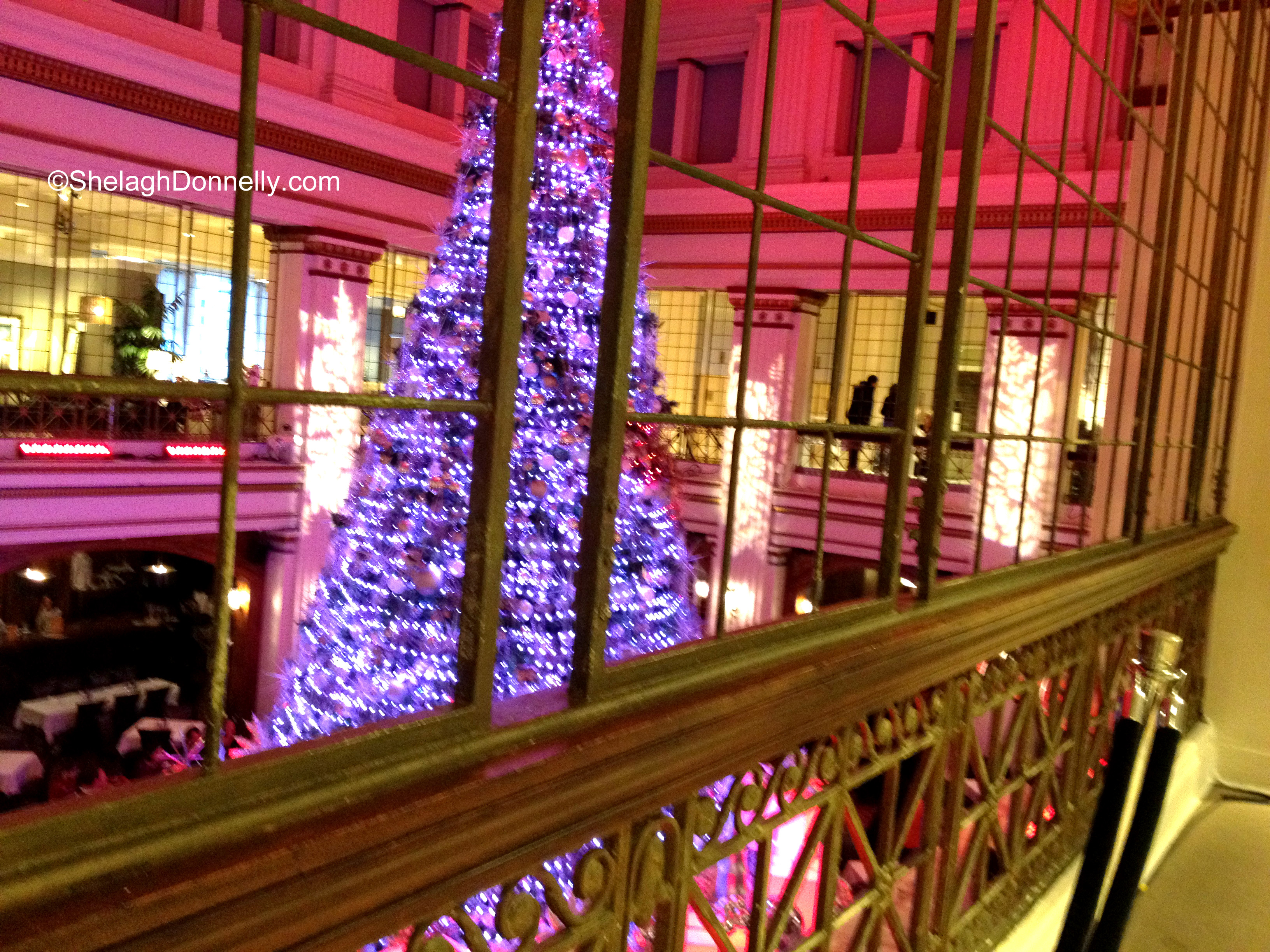
Memories run deep in Chicago, though, and some locals boycott the store – in part because the traditional decor on three-storey Christmas trees in the Walnut Room, circled by a not-so-miniature railroad to be admired by festive diners, has been replaced. People hold near and dear their childhood memories of December lunches with a beloved grandmother or other relatives in the Walnut Room (which opened in 1907), where green and red, and the railroad, were part of the much loved tradition. You didn’t just pop in and nab a table. Today’s Christmas tree is still three stories tall, but it’s said to be swathed in Swarovski crystals. The train is gone, and lighting schemes include pink and blue, with a Macy’s star emanating from the tree and beamed on to the ceiling.
Share this post, and Shelagh's Lens, with others who love to travel

Remembrance Day
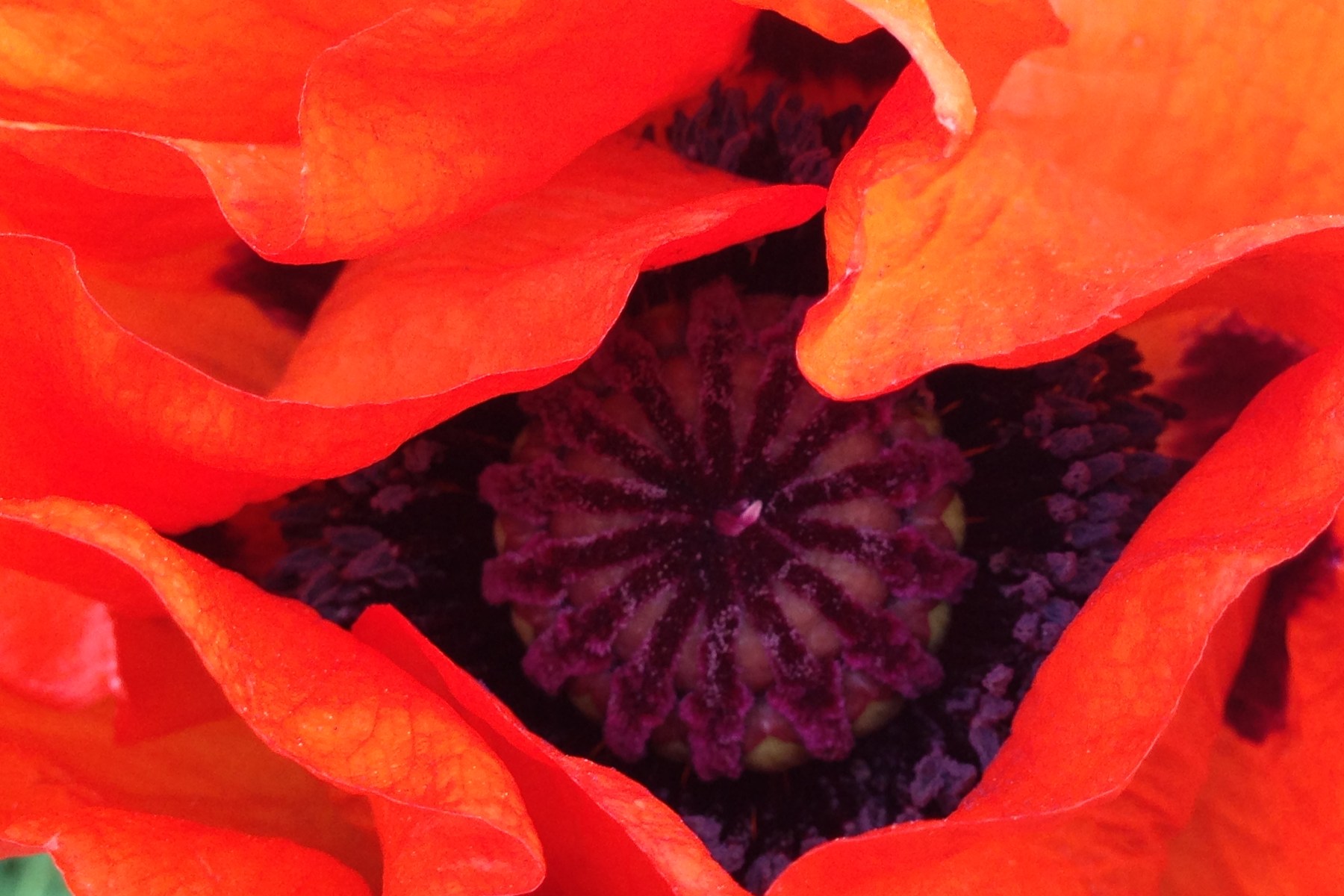
If you’re a Canadian travelling in Chicago, wearing your poppy is one sure way to meet people. Here on business, I’ve been struck by the number of Americans (who mark Veterans Day today) who have stopped to enquire about the poppy worn on my left lapel.
Those of us who grew up in Canada learned and recited, as school children, the poetry of a Canadian physician who served in both the Boer War and The Great War that subsequently became known as World War I. John McRae was a pathologist, professor and poet who graduated from the University of Toronto and interned at John Hopkins Hospital in Baltimore. He elected to serve as a gunner and medical officer in the Canadian Expeditionary Force.
While we, and people in other countries, pause to pay respect on the eleventh hour of the eleventh day in the eleventh month of the year, it was on a Spring day – May 3, 1915 – that Lieutenant Colonel John McRae articulated his experience in a poppy-strewn hell.
McRae wrote of his time at Ypres, “I wish I could embody on paper some of the varied sensations of that seventeen days … Seventeen days of Hades! At the end of the first day if anyone had told us we had to spend seventeen days there, we would have folded our hands and said it could not have been done.”
Under cover of darkness on May 2, 1915, McRae presided over the burial of Alexis Helmer, a friend and former student who died during the Second Battle of Ypres. Word is that, perched in the rear of an ambulance just north of Ypres, Belgium the day after Helmer’s burial, McRae wrote In Flanders Fields in the space of roughly a quarter of an hour.
In the months ahead, the poem made its way to the UK, where it was initially published on December 8, 1915 in Punch magazine. Following publication, In Flanders Fields gained rapid exposure and immense favour. McRae died of pneumonia less than four years later, when he was 45 years young and serving in Boulogne-sur-Mer, France. Today, a century after McRae penned his poem, we will pause to remember.
November in Canada marks the Royal Canadian Legion’s Poppy Campaign, with volunteers and retailers making the vivid lapel pins available by donation across the country. Such poppies first appeared in Canada in 1922 and, until 1996, were produced by disabled veterans who were able to derive modest incomes from the work while also contributing to Canadians’ sense of remembrance. Today, those loonies, toonies and larger demoninations we tuck into a collection box in exchange for a lapel pin continue to be directed to veterans, through services provided by the Legion. Those of us who turn out in increasing numbers for 11:00 a.m. cenotaph services on November 11th typically unpin our poppies after the ceremonies, and gently place them upon a memorial. I won’t be with my family at this year’s service, but I remember, and will pause and pay respect at 11:00 a.m.
People in other countries also mark November 11th, for it was at the eleventh hour of the eleventh day of the eleventh month in 1918 that the Allies’ and Germans’ armistice saw an end to what is now known as World War I. In England this year, there is a compelling art installation outside the Tower of London, with 888,246 hand made ceramic poppies representing the individual Commonwealth soldiers who lost their lives in The Great War that began a hundred years ago.
This year, Canadians pinned our poppies fresh on the heels of the loss of Corporal Nathan Cirillo, a reservist with the Argyll and Sutherland Highlanders. Nathan Cirillo was shot and killed last month while serving as Honorary Guard at Canada’s Tomb of the Unknown Soldier. Today, many Canadians are wearing our poppies with our customary respect – and with fresh tears for this most recent horrible, unnecessary loss.
IN FLANDERS FIELDS
We are the dead: Short days ago,
We lived, felt dawn, saw sunset glow,
Loved and were loved: and now we lie
In Flanders fields.
Take up our quarrel with the foe
To you, from failing hands, we throw
The torch: be yours to hold it high
If ye break faith with us who die,
We shall not sleep, though poppies grow
In Flanders fields.
In Flanders fields the poppies blow
Between the crosses, row on row,
That mark our place: and in the sky
The larks still bravely singing fly
Scarce heard amid the guns below.
We are the dead: Short days ago,
We lived, felt dawn, saw sunset glow,
Loved and were loved: and now we lie
In Flanders fields.
Take up our quarrel with the foe
To you, from failing hands, we throw
The torch: be yours to hold it high
If ye break faith with us who die,
We shall not sleep, though poppies grow
In Flanders fields.

- John McRae (photographer not identified)

Share this post, and Shelagh's Lens, with others who love to travel

The Windy City

Chicago, from which I’m writing, is appropriately known as the windy city, but I’m also finding it a friendly city. The architecture is, as expected, impressive. Here’s a look at the city, and the Chicago River, at dusk.
Share this post, and Shelagh's Lens, with others who love to travel

Southern Skies

In Phoenix, Arizona, people make their way up and down Camelback Mountain from sunrise to sunset. This image will give you a sense of the view awaiting the last of the hikers when they make their way down to the parking lot at the end of a Fall afternoon.
Share this post, and Shelagh's Lens, with others who love to travel

Ode to Porto

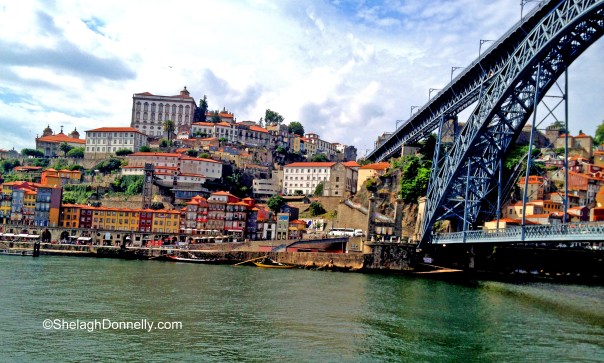
We travelled to Porto, Portugal this past summer, and some images have already appeared on this site. The challenge with visiting some locales is subsequently choosing from an embarrasment of riches in terms of images and memories one could share, and this is true of our time in Porto.
Today, I’ve published a review of our time in Porto to my other website, Exceptional EA; if you’re interested in shots of this trip (or insights should you be thinking of travel to Portugal), you can find them by clicking here.
Share this post, and Shelagh's Lens, with others who love to travel

Into the Light
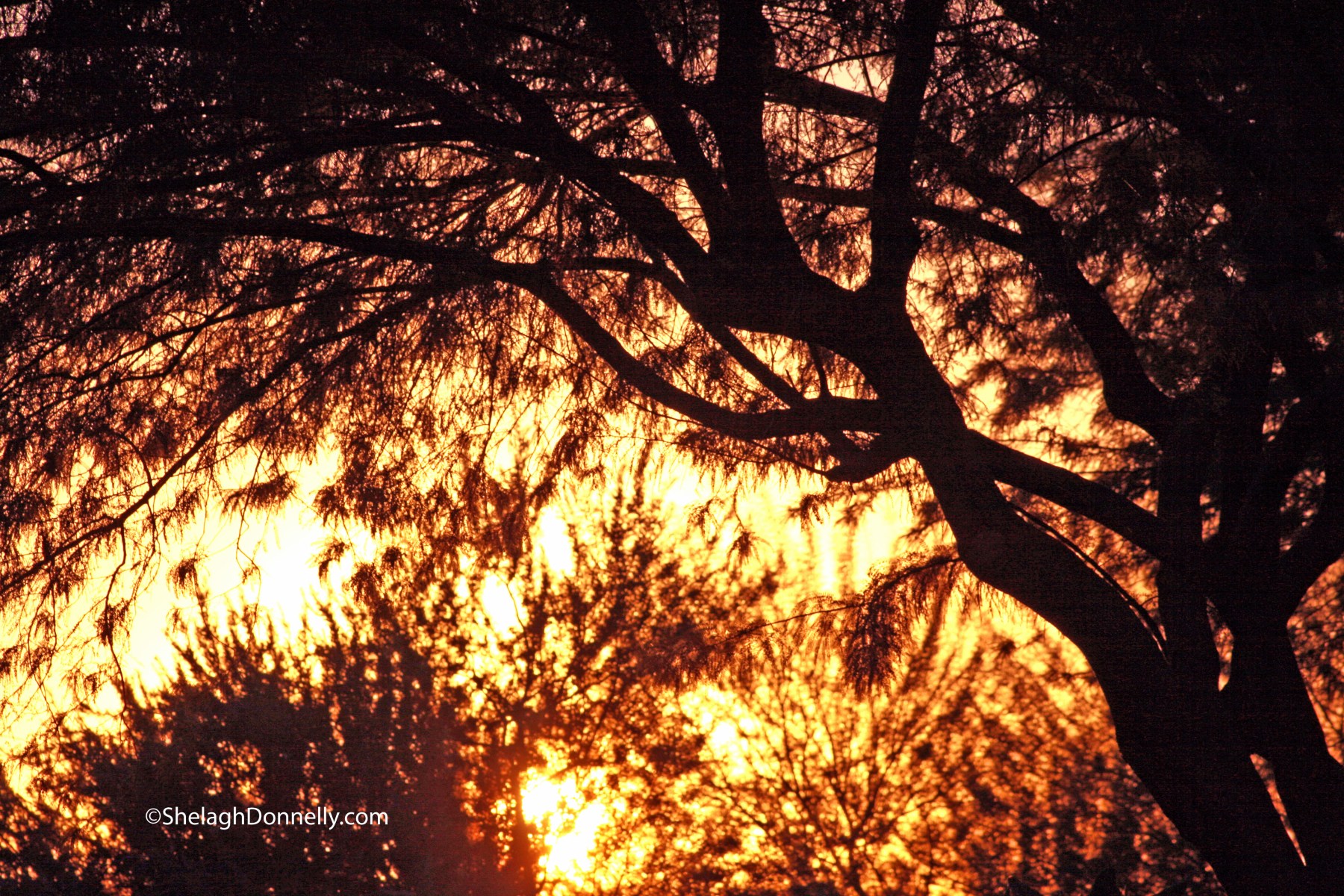
We returned a couple of days ago from Scottsdale and, while I could camp out at Camelback Mountain almost daily to inhale the spectacular sunsets, the sunrises can also make for beautiful images.
This one, with the long reach of the tree limbs, seemed particularly timely for this Halloween morning.
Share this post, and Shelagh's Lens, with others who love to travel

Two’s Company …

… and three, apparently, is not a crowd. This graceful trio of Monarch butterflies would appear to be doing just fine sharing life’s nectar.
Share this post, and Shelagh's Lens, with others who love to travel

Give Peace a Chance

Over the past day or so, you may have seen a multitude of images of Canada’s Parliament Buildings, and so tonight I’m taking you inside Parliament’s Peace Tower and its Memorial Chamber, which is dedicated to people whose lives ended while in the service of this country.
Originally erected as a memorial to those lost to what was then known as the Great War, the Peace Tower houses Books of Remembrance, one of which you’ll see above. A century later, I’m writing with sorrow for the loss of lives yesterday, and compassion for the people of Ottawa and beyond. You might wish to have a look at how Bruce MacKinnon has shared his perspective.


 Shelagh's Lens